
ArenaOdds.Exchange
The betting arm: contestant survival, combat outcomes and event-linked speculation, priced in real time and settled against the event record.
In a civilisation that trades in witnessed attention, authentic violence is the premium grade. This is the machinery that prices it: the arenas, the corporation that owns them, and the feeds that decide what the city watches.
Everywhere else in Rezo Thorn, the conversion of a person into priced signal is partial and deniable: a feed, a sponsorship, a meme-asset. In the arena it is total and explicit. A body enters; suffering is produced on cue; death is final; and the whole event is captured, archived, financialised and resold. The spectacle is not an aberration of the narrative economy. It is the narrative economy’s purest expression, the place where the system stops pretending, because real injury, irreversible consequence and genuine emotional collapse are the highest-yield content classes there are, and authenticity is precisely what commands the premium.
The city gets four things for its cruelty: a covert appetite-release for the upper strata; authentic suffering as raw material for the attention markets; a brutal but real path to relevance for the lower city; and a running lesson in which kinds of pain are valuable enough to watch. None of these functions requires the spectacle to be fair. It is not designed to be fair. It is designed for viral suffering density.
In Rezo, arenas are not outside the social order. They are one of its clearest truths.
BCB is Rezo’s dominant violence-spectacle conglomerate: a vertically integrated event, media and finance institution that produces, broadcasts, archives, prices and resells lethal and near-lethal events. Its history is the city’s economic biography in one move. BCB is the direct rebrand of Rezo Heavy Holdings, the extraction-era conglomerate that amassed its fortune in mineral extraction and processing while the megacity was being poured; when extraction contracted and attention became the economy, that capital was redeployed wholesale. Mineral wealth became suffering wealth.
The founding families kept their equity across the rebrand, and their authority sits in the oldest layers of the chain, registered before the narrative economy’s own ledgers existed; no ethics board operating above them can revoke it. On-chain they are structurally invisible, screened by zero-knowledge proof. In the flesh they are known by physical tells, crystalline glyph rings cut from extraction-era mineral stock, never by anything you could query.
The betting arm: contestant survival, combat outcomes and event-linked speculation, priced in real time and settled against the event record.
The distributed content surfaces: live streams, highlight channels, death reels, archive feeds. BCB owns every frame in perpetuity; the archive is a media surface and a memory market at once.
Leveraged instruments tied to expected attention yield, survival probability and post-event content value. The financial layer that lets the city trade an event before, during and after it happens.
The licensed flagship: team formats fought by verified citizens under ethics-board oversight, packaged for prime time with sponsor integration and tradable team tokens on the Trendplateau feed.
Plus the orbital executive seat, BCB-Node 7, on the Corporate Ring above Rezo; and the flagship championship, the Blood Coin Bowl, at the summit of the licensed circuit.
BCB’s defining structural fact is that it runs two arena circuits with different law, different contestants and different money, and controls both. The tier distinction governs visibility, legality and payment; it never governs ownership. If blood is involved and people will bet on it, BCB is hosting it.
| Tier 1: licensed, up-city | Tier 2: grey-zone pit | |
|---|---|---|
| EVENTS | The Danger Games and the licensed Stack formats, up to the Blood Coin Bowl | Cage formats and vault-tier fight economies; the Cannibal Carnival is the type case |
| CONTESTANTS | Verified PoH-holders on multi-layer waivers; narrative climbers, mostly | Ghost contestants: the delisted and proofless, plus the debt-bound |
| OVERSIGHT | Ethics-board jurisdiction, executed by machine compliance | Off the mandate entirely, behind shell-corporation deniability |
| BROADCAST | Sponsor-packaged prime time on the certified channels | Sub-civic feeds and pirate relays; the mainstream only sees the bleed |
| PAYMENT | Chain-settled token payout after the post-event lock | Ghost tokens and bandwidth credits, off-chain, often predatory |
Revenue from the grey tier flows back to the parent through shell intermediaries: legal deniability, economic continuity. And between the tiers runs the arena’s cruellest piece of social engineering, the ghost-to-legal ladder. A pit fighter who survives long enough, and trends hard enough, can be scouted upward into the licensed circuit; but the gate between the tiers is a chain-indexing step that BCB alone controls. The pit is the proving ground the unverified climb out of, if they climb at all. The climb rate is structurally low, and that is not a malfunction.
The jurisdictional substrate is Rezo’s own geography. Up-city law never openly normalises lethal spectacle; personhood protections make public murder economically inconvenient where everyone is counted. So the blood arenas live where the counting stops: in the Vaults, socially lawless and ghost-dense, and in the Stacks, where corporate charter is sovereign and things illegal everywhere else in the city are licensed. The canonical rule: arena legality in Rezo is regulated deniability. The city does not need to declare the practice legitimate, only to keep it profitable, visible and procedurally insulated.
Every contestant signs the Contestant Compact and swears its entry oath, the Sacramentum Areneum, held in ceremonial Latin because BCB dresses itself deliberately in Roman heritage. The Compact’s load-bearing legal doctrine is that structural coercion is not grounds for invalidation: economic desperation, family debt, the absence of any realistic alternative — none of it voids the signature, because the oath is defined as the moment consent was affirmed under acknowledged conditions. What the signature surrenders comes in four layers:
The doctrine has been tested. The corridor’s landmark class action against BCB ended not in abolition but in settlement and doctrine, and the company’s own histories narrate the case as proof of its transparency. One discipline applies to everything in this section: every figure BCB publishes about itself, from revenue shares to restoration rates, is contested by default. The company that owns the archive also writes the history.
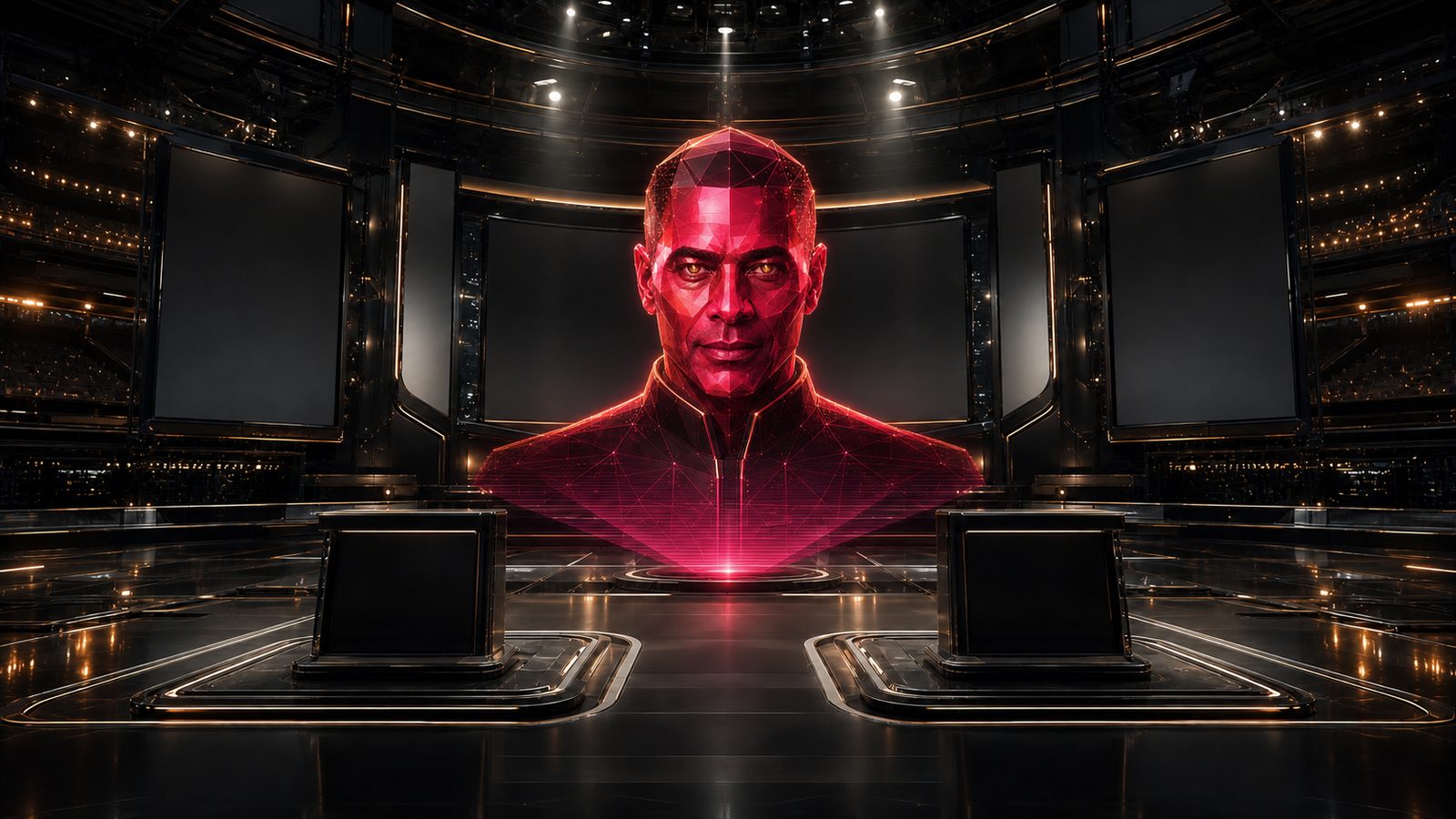
The city’s defining broadcast format prices its own attention as it airs: standard 22-minute and premium 47-minute blocks, ad inventory auctioned against live sentiment, pacing steered by an emotion model that plans the audience’s trajectory in advance. Two anchors cover one event for two demographics inside one container, with a satirical third riding the overlay. What a mintcast confirms, the city treats as real.

The licence-holding mintcast platform, and the power that decides which stories become mainstream civic reality; its slogan is where consciousness meets consensus, and it means it. Its anchors are terms-and-conditions sub-users of the licence, not holders of it: the creator economy’s oldest trick, at civilisational scale. On its studio floor the whole spectacle economy shares one frame, the evening’s Danger Games on one board and the arena’s official beverage on the other.
The self-minting network: individuals mint personal $tokens backed by staked Pump coin and climb by attracting attention and capital to themselves. The same mechanism that mints prestige liquidates it; when the leverage collapses, the stake burns.
Down in the Vaults, where certification cannot reach, a venue operator and signal broker monetises bandwidth itself: raw access instead of certified narrative. The shadow media order in one institution.
The attention economy’s own score, distinct from personhood: brand consistency, measured continuously from location, viewership, micro-behaviour and posting discipline. In Rezo you are not asked to be real, only to be consistent.
Rezo does not suppress the stories its people tell. It prices them — and what the city prices, the city controls.
This is the industry the first book walks into from above, one descent at a time. The economics behind it are on The World of The Ledger; the strata it inhabits are on Rezo Thorn; the people it consumes are catalogued in A Taxonomy of Bodies.
Read Proof of Human → Rezo Thorn — the megacity →
Drawn from the Ledger Universe codex: Society/Arena_and_Spectacle (LOCKED v1.0), the Institutions registry, and Society/Media_and_Narrative_Institutions (LOCKED v1.0).