
Rezo Thorn
Seven kilometres of stacked history on a drowned world: a vertical continent where the higher you rise, the cleaner the air, the stronger the signal, and the more real you are permitted to be.
Watch: Rezo
Part one of six: the megacity at a glance, its strata, its sectors and the billions stacked inside it. The other five parts sit beside the sections they explain, down this page.
Rezo Thorn is not a skyline; it is a stratigraphy. The city was built by accumulation, not replacement: each economic era raised over the last and never demolished, so to descend is to travel backward in time, from the carbon-laminate Heights down through the meme-church Vaults to the Portland-concrete Stacks where it all began. The built form and the social order are one thing: height is the city's reading of personhood, status, and narrative visibility made literal.
A permanent sea of cloud hangs across the lower city and rarely clears beneath the middle districts, at once an environmental fact and a class divider. Above it: light, sightlines, real glass, full verification. Below it: the skyless, flooded depths where the network drops to a grade too weak to even prove you are a person. The whole machine reads top to bottom as a single sentence the city tells about who counts.
In Rezo Thorn, the physical city and the narrative-financial city are the same thing.
Watch: how the city was built
Part two of six: the foundation. Why a world and not a station, the first brick, and how each era of the economy was laid on the last.
Nothing is demolished
Dates in Rezo are SUDR years, the Standard Universal Date Reference, counted from the Ledger’s genesis block. A survey expedition lettered this region’s claims in arrival order between 650 and 700, and this system came second: Beta, the name the chain still keeps. Most of the corridor settles in orbit, but Rezo Prime’s air was survivable unmodified and its ocean cheaper to harvest from the surface, so it won one of the rare planetary charters. Its first brick, the first verified productive transaction written from its resources, was laid around 700; the spindle station rose in orbit around 740, its rings from about 780.
On the ground the city began with industry. The Stacks came first, mass concrete and steel, each one a corporate domain under its own charter: less a city than a string of company towns, one of them run by Rezo Heavy Holdings, known today as BCB. The ocean covers eighty-five per cent of the world and the city stands on an island, so it grew up, not out. Downtown rose on the Stacks in self-healing Geocrete and split into Lower and Upper; for a long time it was the whole of Rezo. From about 950 the narrative economy carried the city up out of the cloud into Midtown, and Midtown built its checkpoints on purpose, into the floor where it met Downtown. Locking Downtown out of the verified city was not planned: the networks simply climbed with the technology, and the old city became the Vaults. The Heights followed from about 1130 in carbon laminate, and Apex Heaven came last. Between 950 and 1100 people began calling the system Cichora Prime; the centre earns the name. To descend in Rezo Thorn is to travel backward in time.
A section through Rezo Thorn
◈ Walk the strata — interactive cross-section →
24 codex locations · story routes · best on a larger screen
Watch: the grid
Part three of six: why a megacity is built on hexagons, how the rings step the pyramid, and how a two-number address finds anything in it.
Rings and sectors
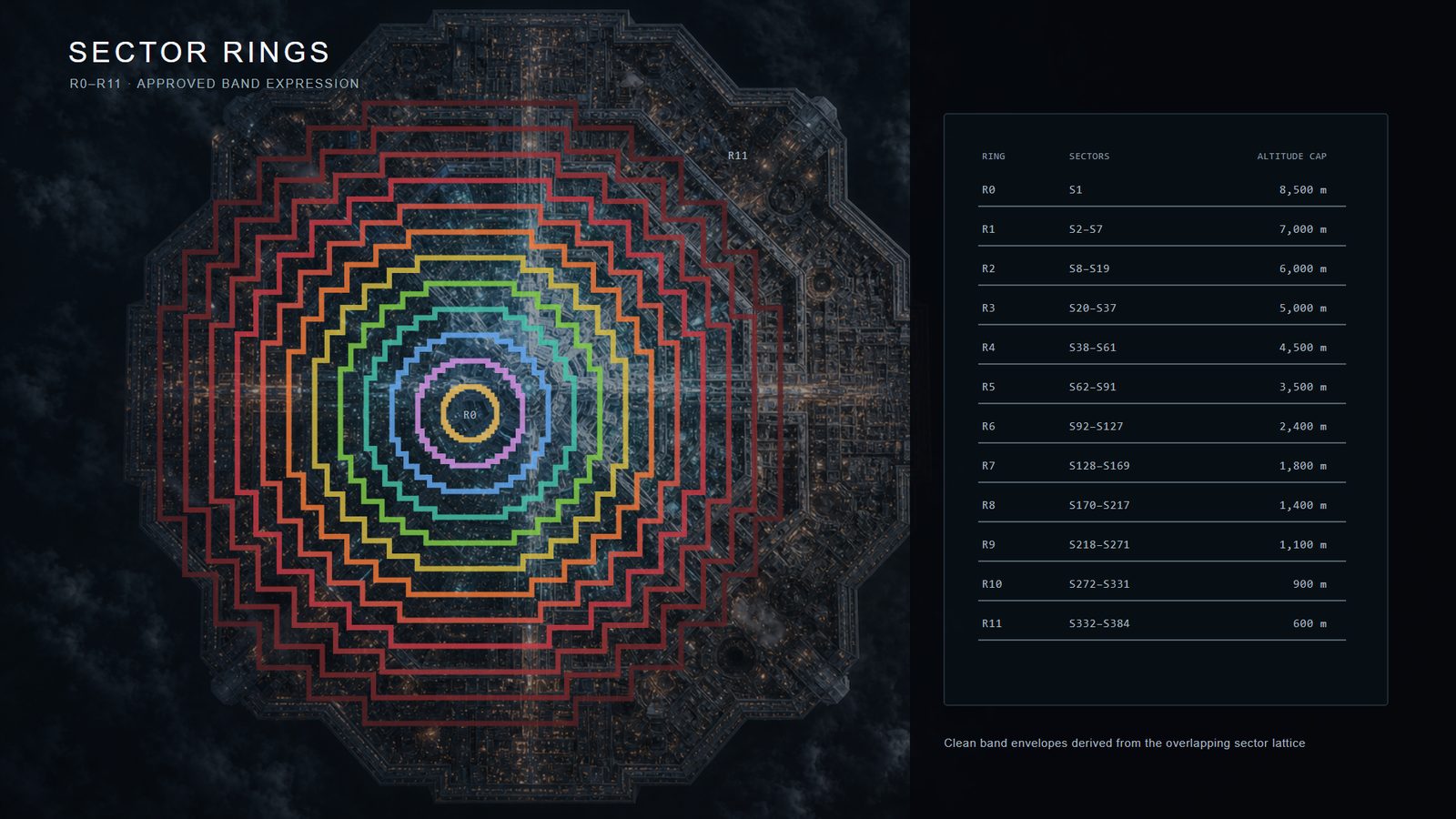
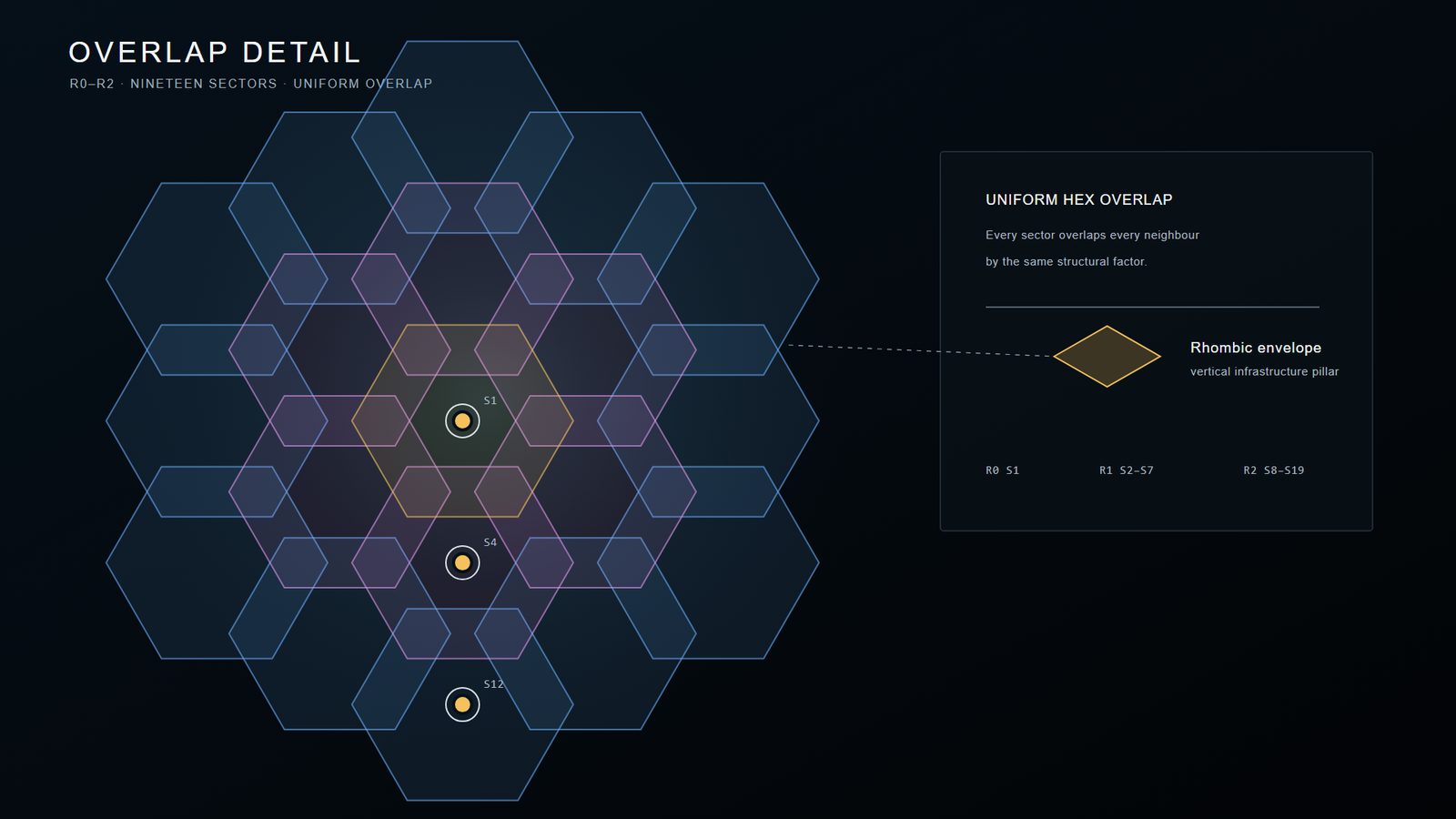
Seen from above, the city is a lattice of 384 hexagonal sectors in eleven concentric rings around the Spine, and every address in Rezo is just two numbers: a level and a sector, L= for altitude, S= for position. The rings are why the pyramid steps: each ring caps out at a lower altitude than the one inside it, so the outer city is always the lower city. The sectors close-pack like a honeycomb, the least wall for equal cells. Where three hexagons meet, the junction is a diamond; every diamond carries risers for the city’s infrastructure, and sixty-four of them run on, unbroken, as the mega-columns that carry the city.
Watch: the summit and the Ring
Part six of six: the Heights and Apex Heaven, the Uptown Tower between them, and the station in orbit that governs the whole city.
Apex Heaven & Rezo Heights
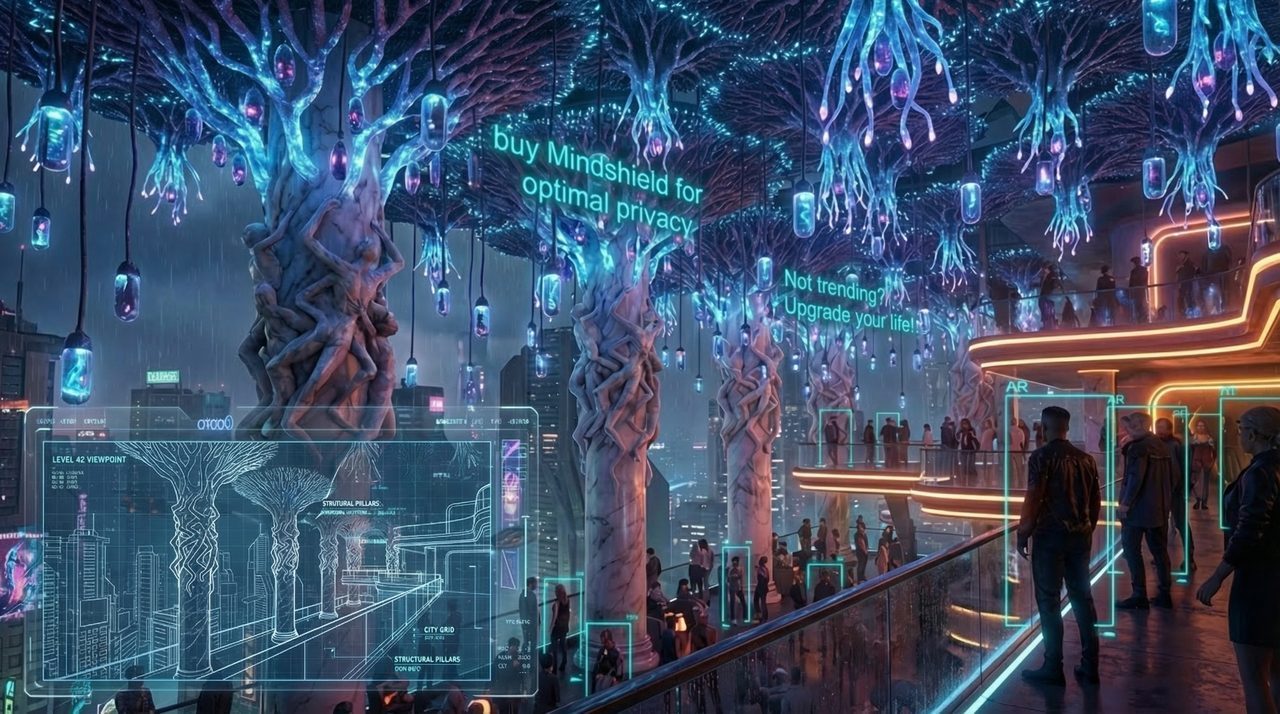
Architecture grown, not built
The narrowing interior of the Thorn: living walls veined with bioluminescence, obsidian and bio-wood, light that shifts clinical-white to amber on occupancy. Here prestige is durable: cleanest air, strongest signal, the heaviest gating. The Heights below are the volatile-celebrity tier, where prestige is bought with light and sightlines: real glass, actual sunlight, solar-view suites above the cloud sea. Above everything, unmanned, run the 375 service decks of the Technical Apex; only the Spine climbs that far, and its Terminal Apex shuttle gate is the city’s one door to orbit.
At the centre of the Heights the Spine is the Uptown Tower, the city’s bureaucratic layer: patent offices, licensing wings and the civil-service offices of the PoH Bureau, with Consensus Plaza at L1450 and Corporation Central at L1499. At L1500 the tower becomes the Apex. Above it all, the city is governed from orbit: three MINDs sit in council as a Triad on the Ring, where their heat radiates straight to vacuum instead of loading the city’s air and water. Day to day, the city runs under one charter through civic offices, human civil servants with AI systems, elected by citizens with full proof of human.
Here: the Apex Suites (L1723-S1, the Spine penthouse) · the Menagerie gala (L1712-S1) · Gwen's Opulence Tower (L1321-S4).
Watch: the middle city
Part four of six: the Lost Level’s customs posts, and the Midtown sectors that feed, build, house and entertain the city.
Upper & Lower Midtown
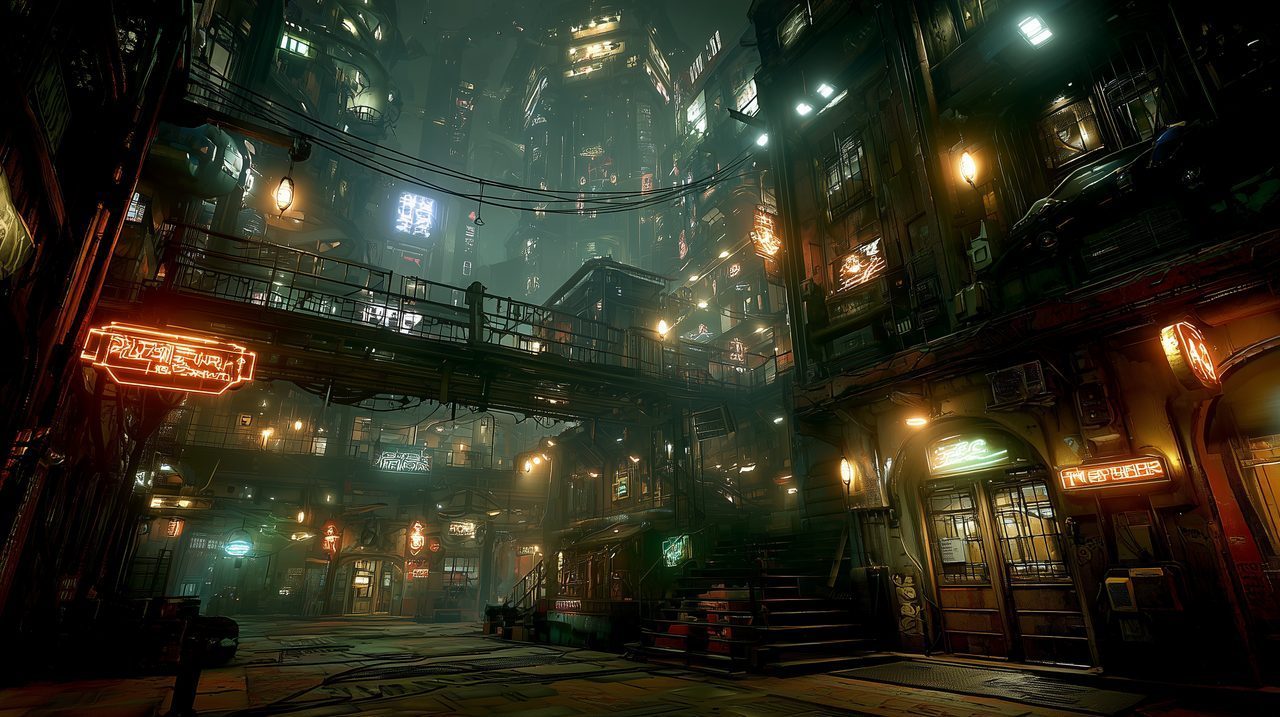
The first light above the overcast
Lower Midtown is the first stratum fully above the permanent cloud: dense, congested, permanently crowded mass (in Rezo, congestion itself is a class signal). Climb into Upper Midtown and the Thorn's taper begins: commerce corridors, ad towers, AI enclaves, and the Trendplateau Exchange, the certified meme-asset trading floor where attention is priced.
Above the cloud, the city works. Most of its food is grown in four Midtown sectors from the ocean’s harvest; the Press (S59) and the Freight (S60) make and move what it needs, and what they cannot use is pumped downhill to reprocessing in the Vaults. Its districts and named sectors each keep a register of their own: the Augmentation District, where bodies are maintained at volume; the Circus, BCB’s sealed column of stacked stadiums; the Zheng District, where Mandarin is written into the settlement charters; the Seam’s residential trenches; the World Plaza, with the Jeda Worlds Plaza one of its sub-plazas; and the Neon Row, lit twenty-five hours a day.
Here: the Magtrain Terminal (L753-S5) · Jeda Worlds Plaza (L1150-S9) · the Trendplateau Exchange (Upper Midtown).
The Trendplateau & the Lost Level
The Lost Level is a single transitional civic floor, neither Midtown nor the Vaults: the last lit remnant of the older city the Vaults used to be, and the first place on the way up where reliable daylight breaks the cloud. You can read the boundary in the walls, where the depths’ wet Geocrete gives way to carbon-laminate panel; the social boundaries are kept deliberately elastic, but the physical one is solid and blatant. The Dandelion Security Node (L751-S5) is one of the floor’s customs posts, an EQUIV-grade checkpoint run by an AI under the city’s charter: citizens already on record take the fast lane, and for everyone else a full scan writes a new record.
Pressed against it in Sector 46 sits the Trendplateau ground, the district the trend platform was named after, not the other way round. The locals call it the Kill Zone, dressed up as a carnival: bootleg emotions and black-market memories, noise-fountains running evaporating liquid data, living billboards with surgically altered voices, and the broken theatre spire standing over all of it. One column further down the same sector, the carnival’s salvage shadow: the Cannibal Gardens sit directly beneath the Kill Zone at L724-S46. Carnival above, cannibal warren below.
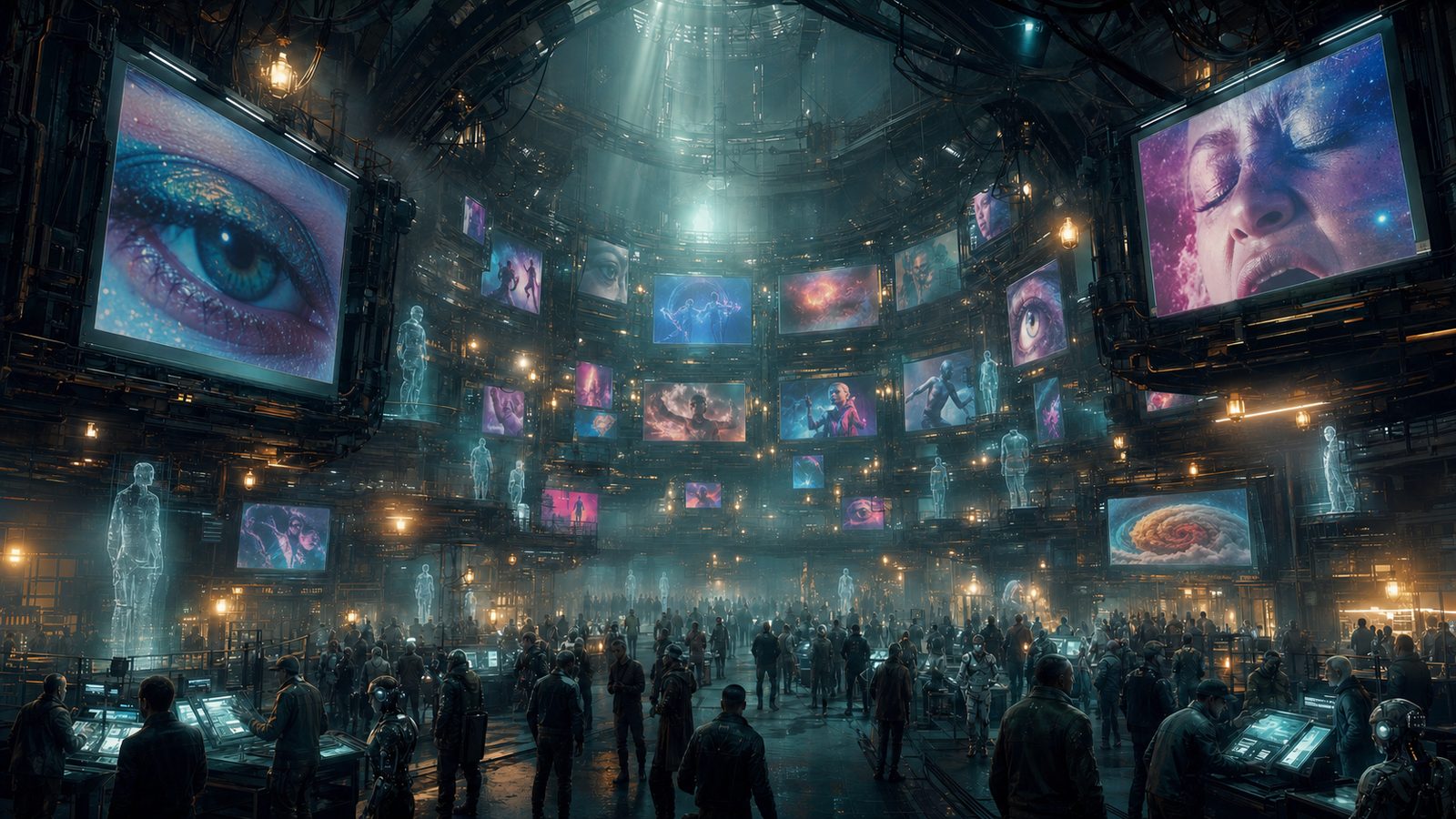
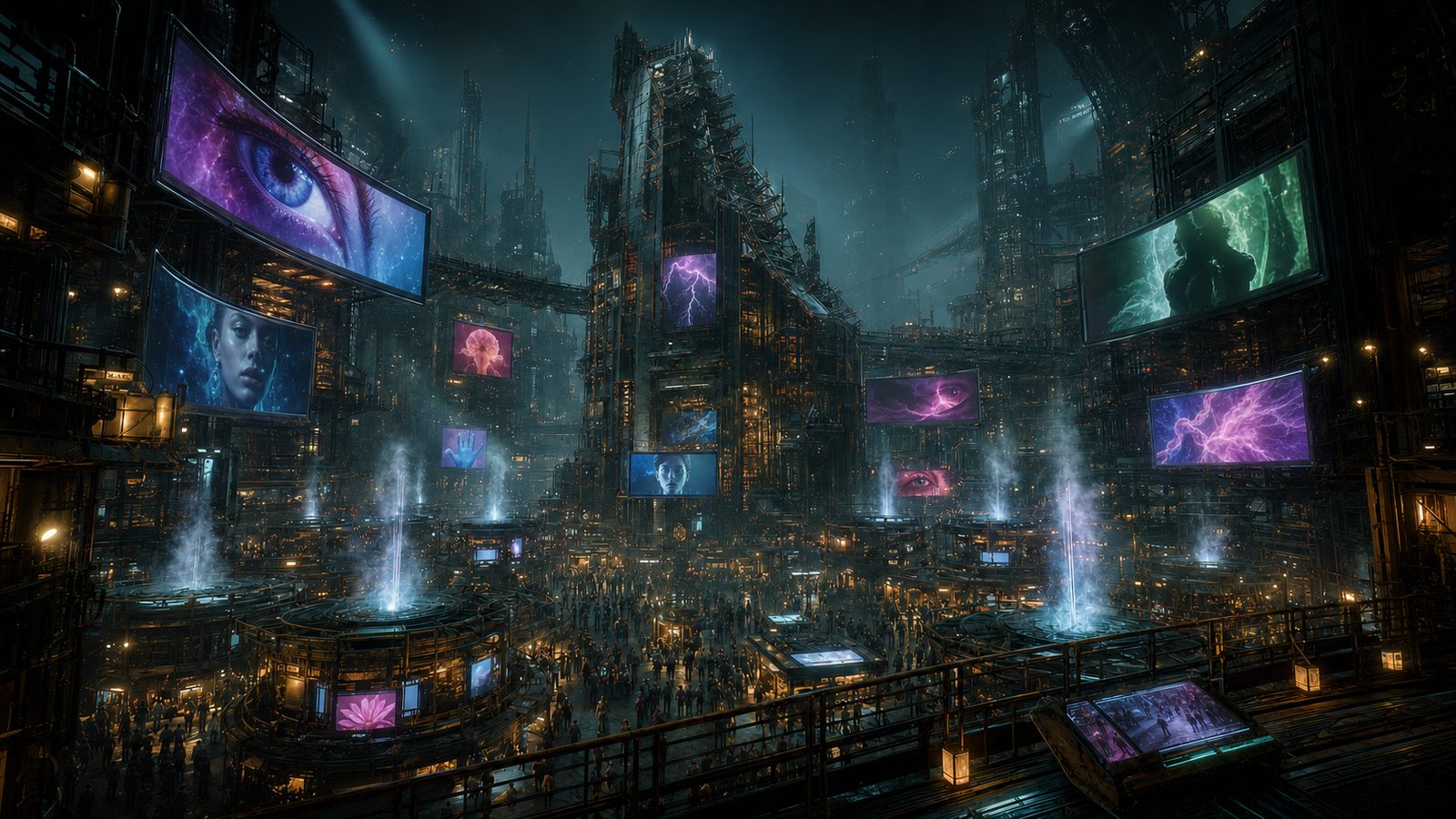
The market hall of the Trendplateau, and the Sector 46 theatre spire on the Lost Level: the seam where the lit upper city meets the dark.
The Vaults
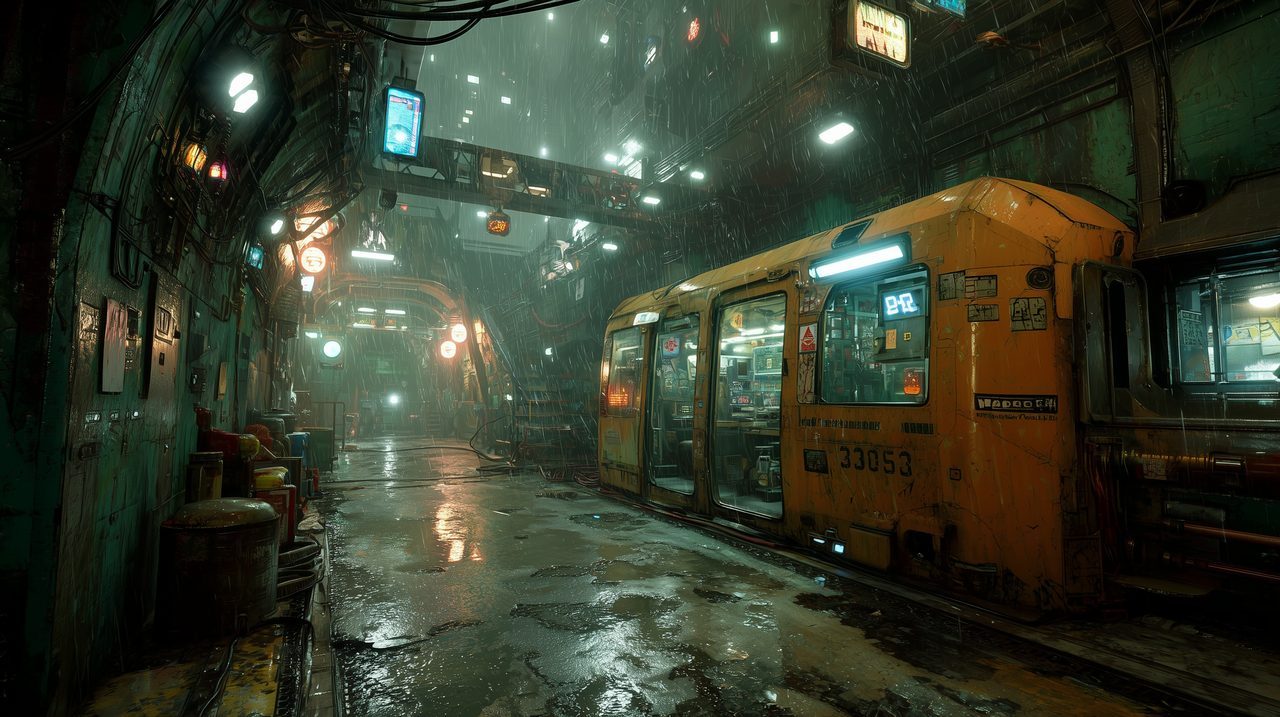
Where social death becomes spatial
A two-kilometre decayed overbuild atop the industrial root, drowned in the permanent cloud: skyless, wet, perpetually dim, the lower bands flooded. This was once Downtown, Lower and Upper, the city that grew on top of the Stacks before the narrative economy; it was never demolished, only built over and locked out of the verified city above, and its ghost infrastructure now houses the ghost population. Inside, many still call it Downtown, and the old signage still stands. Most of Proof of Human lives here.
The signal is the sentence. Vault hardware is SUB-grade: strong enough for the bedrock currency, sanctuary residency and the meme-church, but too weak to carry a personhood re-attestation handshake. That is the structural lockout that strands the ghost class; down here nobody can prove their way back up without physically climbing to an EQUIV-grade node first. Personhood is not socially decisive in the Vaults. Survival, barter, bandwidth and shadow affiliation are.
HiveNet, the public civic mesh, is densest at the top of the city and thins down the strata. In the Vaults it is reached only at paid, shielded nodes with a valid key; below it run the sub-layer nets, unsecured and needing no proof of human.
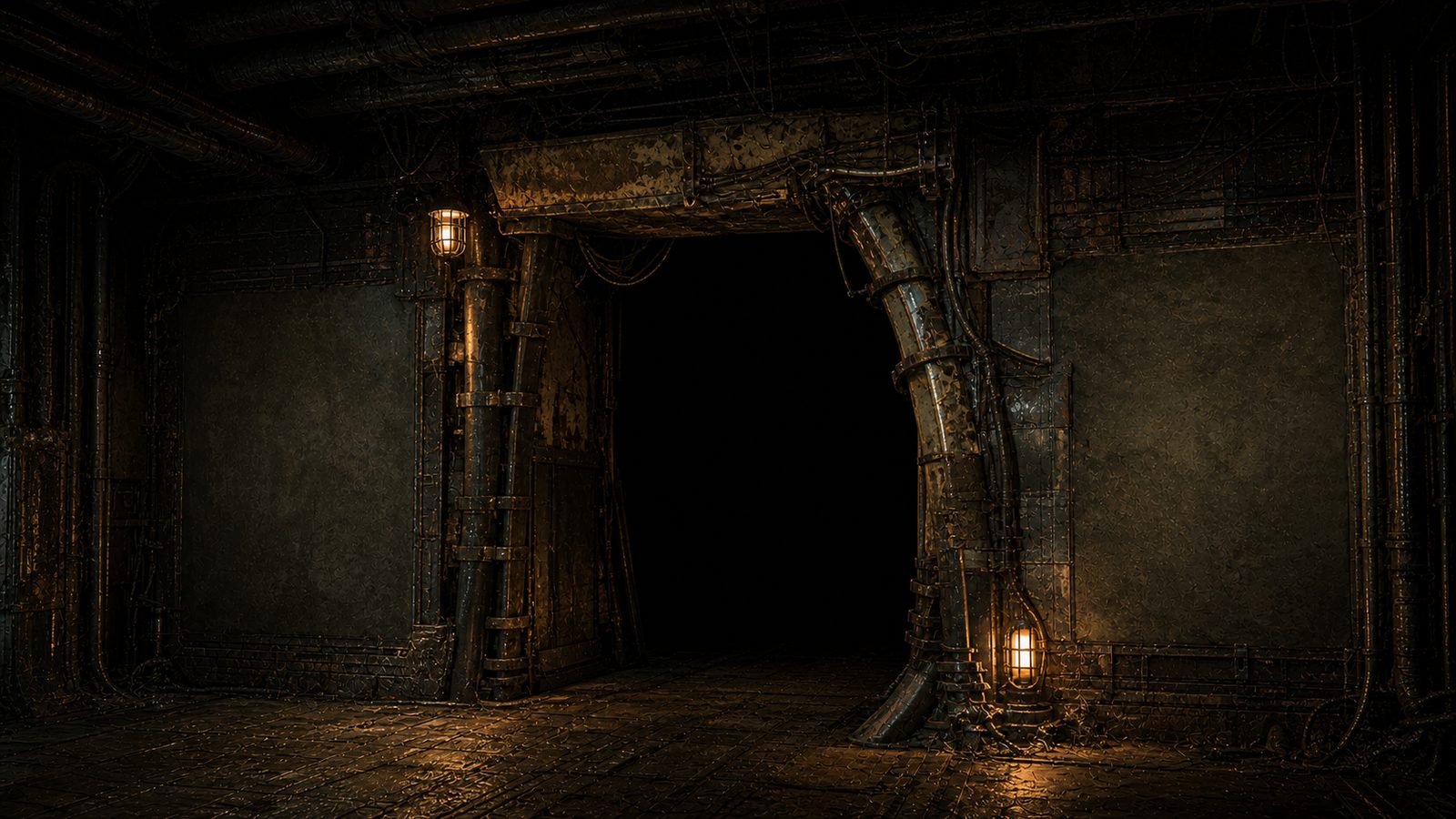
The Stacks
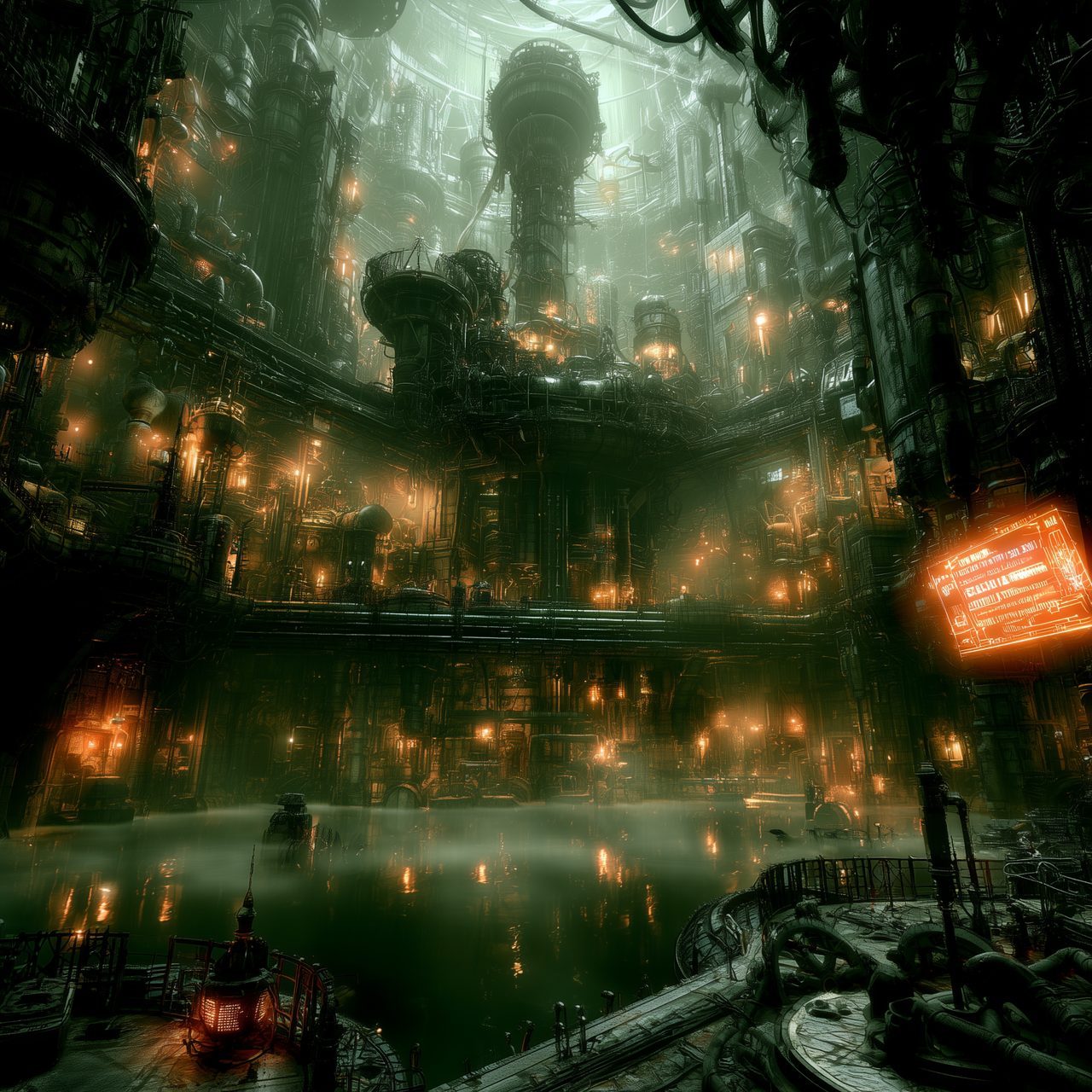
The thermal & water heart
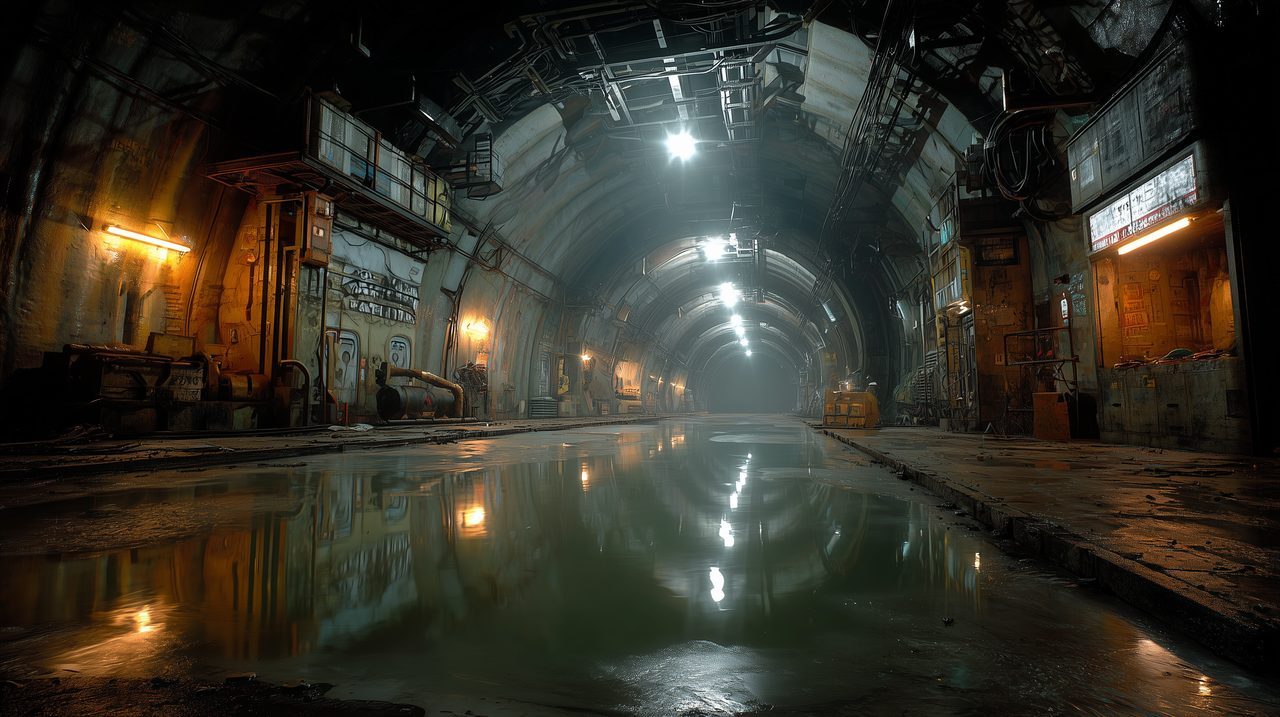
The 332 km² octagonal base, tiled in hexagonal sectors, that the whole megacity stands on: factories, refineries, desalination and power, the city's thermal and water heart, where water is made and rationed upward. Mass Portland concrete and carbon-steel rebar, centuries weathered, the lower 100–200 m flooded (the "crying walls"). Not lawless but corporately sovereign: by charter, things illegal elsewhere are permitted here, most visibly the licensed blood arena of the spectacle economy.
Here: the Stack-106 arena, the Coliseum (L240-S106) · BCB Event Operations (L199-S106) · the descent gate above (L251-S106, the Vaults boundary).
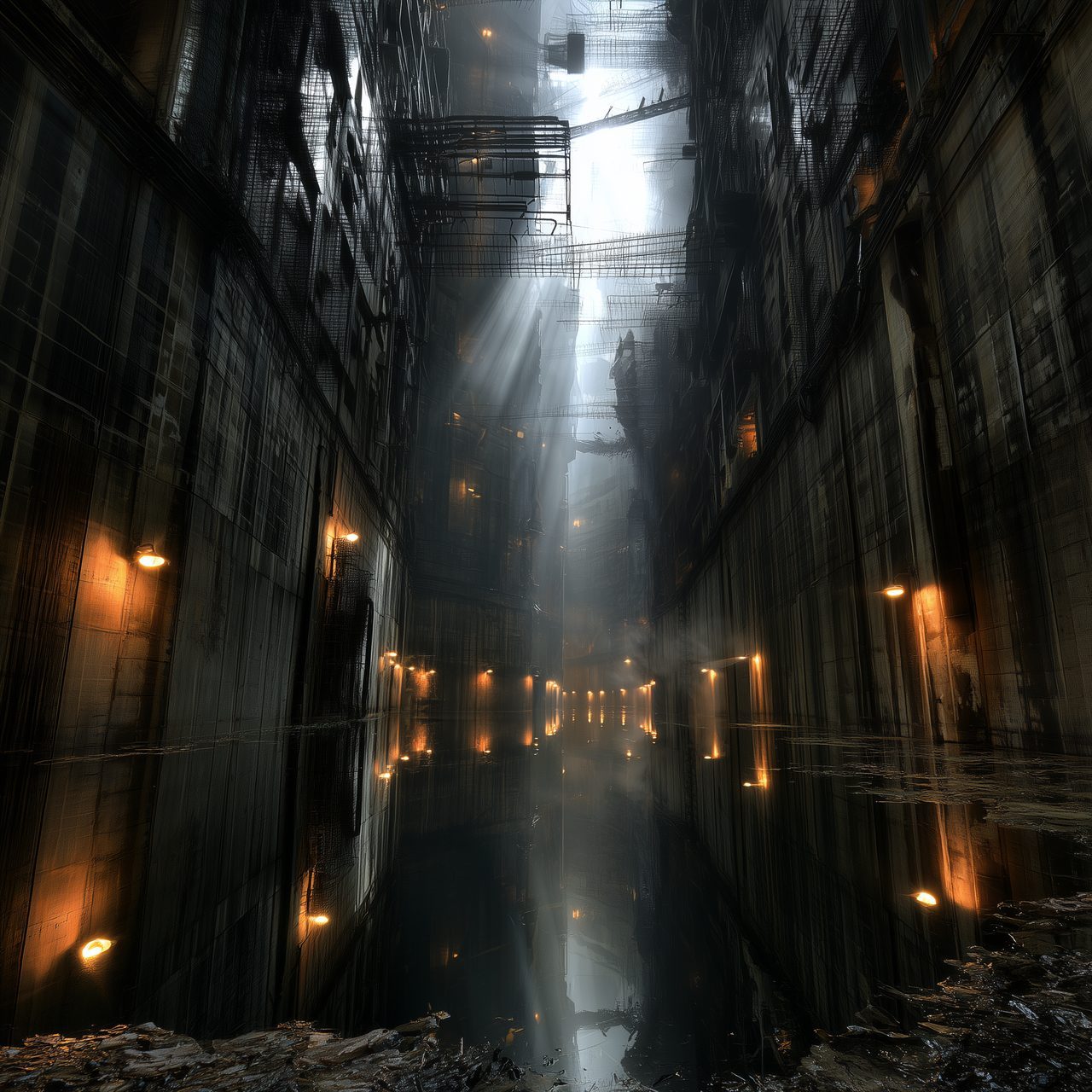
Down at the waterline
Between the mega-columns the base runs out to standing water: flooded service canyons where the only daylight is a thin shaft from kilometres above, sodium lamps stud the concrete, and water sheets endlessly down the walls. This is the waterline the whole vertical city is built to climb away from.
Watch: moving through the city
Part five of six: across the city, up it, and off the world.
Across is a ride; up is gated
No public lift runs the city’s whole height. At ground level eight spurs, one on each face of the octagon, run out to the ocean platforms and the extraction outposts, and freight climbs inside the diamond mega-columns. Below the Lost Level the old transit is dead track and collapsed shafts, though some shielded tunnels still serve the Vaults as highways. When Midtown built its checkpoints, every line that crossed the Lost Level was cut there, so that the only ways up run through a node.
From the Magtrain Terminal (L753-S5) magtrains run across the city, and the climb is made by lift, bank by bank: every bank ends at a zone threshold where standing is proved again before the next one boards. Going down needs no proof. Express cars check the destination’s full grade at the gate, then pass every threshold sealed, collapsed into boarding, never skipped. Six magtrain spokes run out from the Spine to the Heights’ tower clusters; at L1500 the sky-lift stops, its lights go out, and a scan runs in the infrared and ultraviolet before Apex Heaven admits anyone.
Off the world there is one door. The apex lift leaves sealed from the base of the Thorn and climbs the Spine to the Terminal Apex, the shuttle gate: customs, a proof-of-human scan, and every departure registered on the chain. Every passenger craft docks at Port Ascendancy in orbit, and from there an eighteen-node beacon lattice leads out to the fold node, thirty AU from the world.
Where things happen
| Location | Address | Stratum |
|---|---|---|
| Terminal Apex (shuttle gate) | T-decks · S1 | Technical Apex |
| Apex Suites (Thera-Luun) | L1723-S1 | Apex Heaven |
| The Menagerie (gala) | L1712-S1 | Apex Heaven |
| Opulence Tower (Gwen) | L1321-S4 | Rezo Heights |
| Heights Magtrain 4 | L1250-S4↔S1 | Heights / Upper Midtown |
| Jeda Worlds Plaza (Sparen) | L1150-S9 | Upper Midtown |
| Magtrain Terminal | L753-S5 | Lower Midtown |
| Dandelion Security Node | L751-S5 | The Lost Level |
| Trendplateau / the Kill Zone | L751-S46 | The Lost Level |
| Cannibal Gardens | L724-S46 | Upper Vaults |
| Church of the Second Pump | L721-S15 | Upper Vaults |
| The Crypts | L720-S15 | Upper Vaults (sublevel) |
| RIG-THETA-73 (Cannibal Carnival) | L654-S73 | Upper Vaults |
| Maintenance Corridor 19 / Pillar 48 | L552-S30/S15 | Middle Vaults |
| The Elysium | L552-S29 | Middle Vaults |
| OctoPlaza 75 (Skin Market) | L500-S75 | Middle Vaults |
| Arena descent waypoint | L594-S106 | Middle Vaults |
| Arena prep / descent elevator | L251-S106 | Lower Vaults (boundary) |
| Stack-106 arena (the Coliseum) | L240-S106 | The Stacks |
| BCB Event Operations | L199-S106 | The Stacks |
The city didn't grow; it accumulated — each generation stacking its dreams atop the ruins of the last, the oldest spires sagging under the weight of newer, sleeker needles of chrome and carbon-fibre.
One zoom out: the orbital Ring and the wider Cichora Prime system that Rezo Prime sits inside.
Cichora Prime — the system The Corridor
Drawn from the Ledger Universe codex: Geography/Rezo/ (Rezo_Master + Structure & Addressing + the five strata subs, LOCKED v1.0). Strata images from the Visual Bible; the ring plates are from the approved Rezo Map Suite; the cross-section is hand-built inline SVG on the Ledger skin. Schematic, not to scale.
What does Rezo look like to someone who has to keep climbing?
Proof of Human starts high in the Thorn, and Chapter 2 goes higher still. The novel is free to read here, chapter by chapter, and like every Ledger story it stands alone: you need no lore to start.