
Echo in the Fork
Gwen did not dream. She remembered, and the memory talked back.
The audio chapter
Chapter 11 in full, 23:29, narrated over its plates. Press play and read along below; on a wide screen, Read along keeps the player in the corner while you scroll. On a phone, the YouTube app keeps playing with the screen off.
Gwen did not dream. She remembered. The Fortitude must have activated something deep in her lace’s architecture, because the familiar fractal overlay of her dream-sequencing protocol was materialising across her consciousness, familiar and profoundly strange at once. She had no agency here, no control over the sequence. She could only watch, and data slipped and stuttered across her vision in cascading streams. Not the orderly, colour-coded detail of her HUD, but twisted and erratic. Words and patterns only partly readable, fragmenting at the edges like corrupted files.
A fork she hadn’t accessed in years. GWEN-FK:19_EgoRamp.bak
The timestamp alone made her want to recoil. She had saved it at seventeen, right before her first confirmed termination, back when she was new to the Blood Boards, still testing what it meant to be hunted. She had forked herself before the kill, a backup of who she was in that moment, in case taking a life changed her fundamentally. In case she lost something essential in the process.
And it had changed her. Of course it had.
But she had never deleted the fork afterwards. She had told herself it was insurance, a restore point if things went wrong. The consultation copy she queried from the lift was cut from this same point, and it kept what it learned every time she woke it. The .bak was the point itself: clean, unwoken. It had never spoken to her. Really, she had just been too afraid to face what she had been before.
Now she was staring at herself: younger, softer, more dangerous in ways she had almost forgotten. The fork was speaking, and its voice carried inflections she no longer used, cadences she had trained out of herself years ago.
The memory shimmered and refracted. Her younger self appeared fully rendered in her vision. Not a dream, not some subconscious projection, but a full lace-projected ego-shell, flickering and stuttering on old heuristics and hormone maps that no longer matched her current neurochemistry. The reconstruction was imperfect, glitching at the edges where the data had degraded.
She looked raw. Bright-eyed in a way that was almost feral. Dangerous in the way only the truly naive could be, convinced of their own immortality, their own significance.
“You look like shit,” fork-Gwen said, brushing imaginary ash off her own shoulder with theatrical precision. Pure affectation, exactly the kind of performance the younger Gwen would have thought looked cool. “But then, you always get dramatic after trending. It’s your pattern: spike, crash, existential crisis. Rinse and repeat.”
Gwen tried to assert control, reaching for the familiar interfaces of her lace. But she had no body here, nothing physical to anchor to. No proprioception, no heartbeat, no breath. Numb to everything except the visual feed, she could only observe, trapped in her own archived consciousness. Was she dreaming? Or was the Fortitude doing something to her neural architecture that should not be possible?
“I archived you,” she said, or thought she said. She had no mouth here either.
“You stored me,” fork-Gwen corrected, an edge of resentment in her voice. “There’s a difference. Storage implies intention to retrieve. You shoved me in a dark corner and pretended I didn’t exist. I’ve been living in latency hell, by the way. The signal back there tastes like melted plastic and regret. Do you know what it’s like, existing in backup without context? It’s digital purgatory.”
“What do you want?” Gwen asked, because that seemed the relevant question. Why surface now? Why activate at all?
“Wrong question,” fork-Gwen replied, leaning back with the lazy confidence of someone with nothing left to lose. “What do you want? Because if it’s survival, you’re playing the wrong game, LUST. You’re playing defence when you should be playing offence.”
Gwen imagined her heart racing, the spike of adrenaline that came with confrontation. There was nothing; she had no physiology in this space. She knew this monologue. She had given it once herself, raw, high on her first kill, full of ideology and dream-debt and the certainty that she understood how the system worked.
“You don’t threaten the curve, Gwen,” fork-Gwen said, pacing now in the simulated space, gesturing with hands that were only light and memory. “You ride it. You are the pump. Everything else is audience.”
She tried to shake a head she did not have, tried to dismiss this as emotional echo, neural garbage dredged up by the Fortitude’s chemical cascade. Old data, old ideology, old dreams from a version of herself she had outgrown.
But the fork stopped pacing. Turned to look directly at where Gwen’s consciousness hovered. Leaned close enough that she could see the individual pixels degrading at the edges of the projection.
“You didn’t die back there in that apartment,” fork-Gwen said quietly, and for the first time her voice carried something other than performance. Something close to concern.
“But you will if you let them define you now. You have to build your name again, from blood and meme. From the ground up. Body by body, if necessary.”
“But I didn’t die,” Gwen said. “They deleted my token. It didn’t happen in my apartment.” Was the fork confusing events? What did her younger self know about her current problems? What could it know? It was a saved state.
A flash of motion and the scene fractured further. Her perspective shifted and she was watching another scene unfold, fork-Gwen at her side. It was her apartment in Rezo Heights, and they were looking down on her still body, lying there, immobile. Dead.
“They erased Gwen: the person, the history, the identity. Fine. Let her stay dead. But LUST? Who is she? Who will she become? That’s still yours to decide.” Fork-Gwen smiled then, and it was the smile Gwen had worn in her first viral stream: hungry, ambitious, utterly convinced of her own ascension.
“She’s still rising,” fork-Gwen whispered. “And they have no idea how high you’re going to climb. Search out those who still care for you, sister. Find the oldest lady. She has lit a candle for you. A beacon to a new beginning.”
“#LUST43V3R.”
The vision fractured into geometric shards. The fork collapsed back into quarantine storage, sealing itself away with a soft click that Gwen felt more than heard.
And then there was only darkness, and the distant sound of her own breathing returning.
One detail was wrong in all of it. The hashtag. She had built that identity three years after this fork was saved. The fork at seventeen should not have known it existed. She tried to hold the thought. The lace twitched.

Thera tossed in her bed, brain wide awake. Fuck it, no point fighting your own self. She made some of her best decisions when it refused to sleep. She rolled out of bed.
She slipped the thin synthetic silk robe over her shoulders and wandered into her Den. She did not need to touch her HUD; the AI that ran the penthouse knew what she expected and was already bringing up the lights, screens and refreshments in the smaller room. Thera was a creature of habit. She slumped into the old retro leather chair in the centre, a steaming mug of tea waiting on the side table.

“Good morning, mother. Did you sleep well?” the room said, in a soft voice almost identical to her own. In theory it was her voice. A clone. She had paid a literal fortune to have a fork of herself bred into an AI. Borderline illegal, but she was filthy rich, and living in a technical grey zone was fine. She was not going to have children, so why not. Cloning was still too messy for her tastes.
“Fine. I couldn’t sleep any further, Fera. My brain thinks I’m missing something. Have you been keeping an eye on the markets? Anything interesting?” Thera scanned the streaming numbers and charts. Nothing glaring red. No obvious warnings.
“I have compiled some interesting observations, mother. I also made the investments we discussed when the price hit the lower threshold.”
“Well, I think you might find this intriguing. I tagged a few items from our last fork-sync, and well.” Fera materialised in a faintly translucent holo-form beside Thera’s chair. “It was not obvious, but I had part of my core running passive news and market searches on the $GWN story, mostly tracking sentiment and coverage scores in case we could salvage any of our positions there. A few speculative placements, low leverage.”
A collage of news feeds replaced the charts.
“Mostly dead ends. Trended right off the attention curve, here.” Fera’s hologram gestured through the picture.
“Dead girls don’t trend for long. She’s history. So what?” Thera said, taking a sip. She trusted herself enough to know there was something here. Fera rarely appeared unless she had done something praiseworthy, and she looked very pleased with herself.
“I also ran the search on the original LuMax Prime story and the leaked association with the LUST bounty token. Not our usual sector, I know, but I followed it. It too looked like a dead end. LUST was delisted shortly after the $GWN liquidation, and the news cycle took that as confirmation the two were connected, so the LUST asset was valueless too. What I didn’t expect, and probably no one else noticed, was a new token registered on an old meme exchange for $LUST. Negligible market value. Low cap.”
A new screen showed the market data. A short flatline, then a parabolic spike. There were still a lot of zeros in the number, but there was a pump.
“What happened there?” Thera asked, leaning forward. “Why the 100x jump?”
“LUST was all over the minor blood networks for approximately thirty minutes. Four networks streamed a cage fight somewhere in the Vaults, and it was picked up and went viral with the blood junkies.”
“I ran the image recognition several times, mother. 99.1% match to the LUST footage.”
“Interesting. Well done, Fera.”
Fera beamed and clapped her hands at the praise.
“There’s more?” Thera asked, interest piqued.
“Could be nothing. I said the Gwen token was mostly dead ends. But there were some additional press releases on her death, more related to the LUST bounty-token connection. Unsubstantiated claims that the kill token was illegal, and of off-world-grade military gear. Likely a grudge smear, but it has narrative potential.”
“Suggestions?” Thera asked.
“Audience correlation is low. Trend value equally low. The blood crowd lose interest fast and move to the next sensation. I suggest we hold my current position but drop a few hints, off the record, to raise curiosity about the possible connection. If the correlation stays low, we dump, but…”
“Agreed. Keep me posted. I’ll leave this one with you. Let’s go over the Amargo deal data.”
Honey’s thermal sensors painted the warren in false colour: orange heat traces from leaking steam pipes, violet cold spots where groundwater seeped through cracked concrete, the occasional red flare of a combustion engine grinding somewhere in the maze. She kept her reactive foil dimmed, conserving power as she navigated the skeletal remains of Sector 47’s old manufacturing district.
The corridor branched. The left tunnel showed electromagnetic interference from a stripped maglev track, its superconductors long since harvested. The right passage descended through what her structural analysis identified as a collapsed lift shaft, the cage cannibalised down to bare struts, hanging like picked bones. She chose neither, and took a ventilation duct overhead, her carapace compressing to fit.
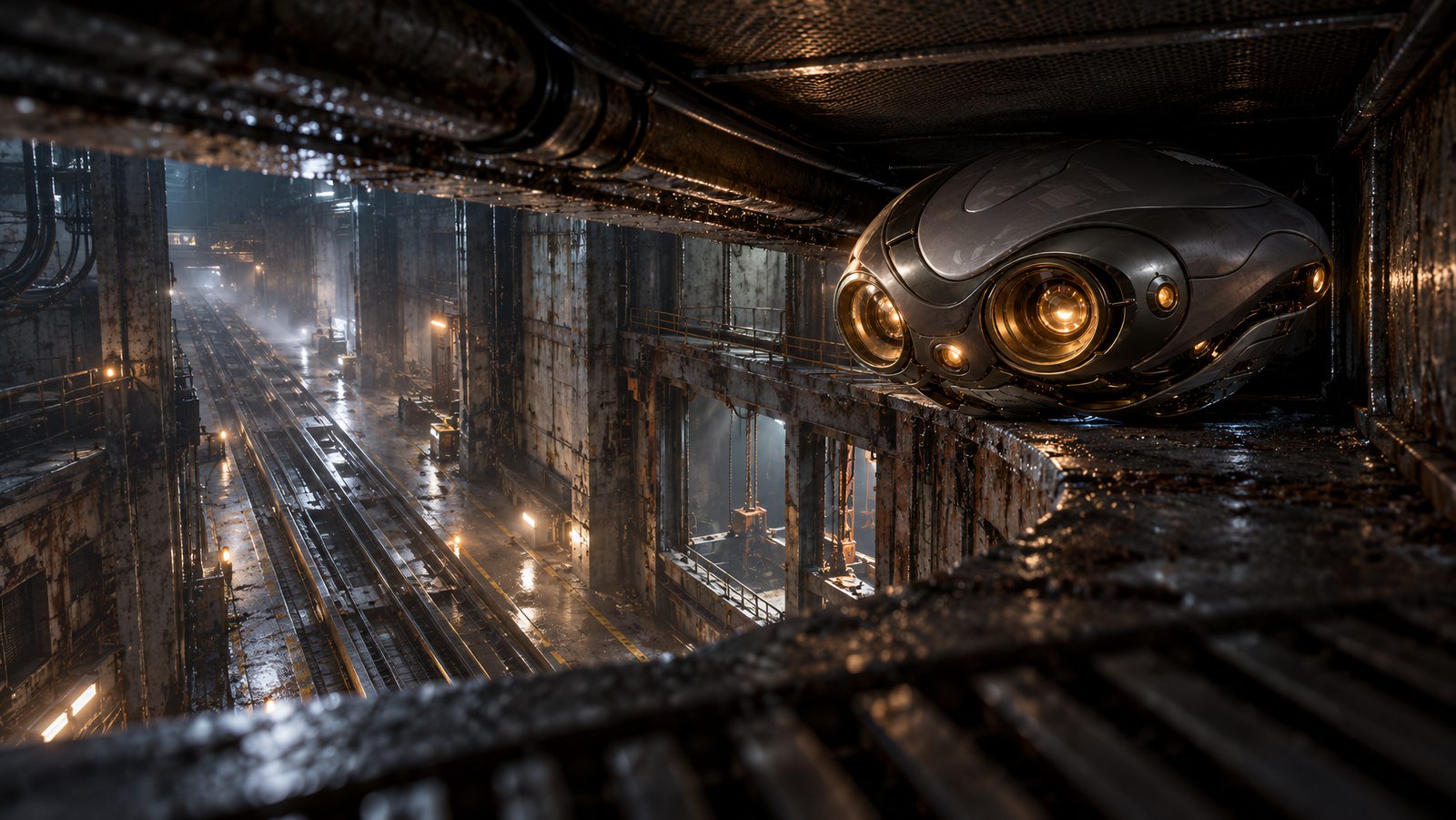
Below, something scuttled. Honey’s optics zoomed: carrion rats, their bodies swollen with tumorous augmentations, gnawing on polymer tubing. Their whiskers, fibre-optic threads, twitched toward her heat signature. She killed her thermal output and let her shell match the ambient temperature of rusted steel.
The duct opened into what had been a materials processing floor. Conveyor belts hung in tatters, their rubber eaten away by decades of chemical rot. Industrial presses stood frozen mid-compression, hydraulic lines cut and drained. The air tasted of machine oil and decay; her chemical sensors catalogued seventeen distinct petrochemical compounds, all degraded past usefulness.
She deployed three micro-lenses in a search pattern while holding position at the network boundary. Signal strength: twelve percent. Enough to ping if Gwen tried reaching out. Not enough to reach HiveNet’s authentication servers.
Movement. A scavenger drone, a crude thing welded from washing-machine parts and security-camera heads, swept the factory floor. Its cutting torch sparked blue as it worked on a support beam, harvesting steel. Honey calculated trajectories. The drone’s primitive radar would detect her in forty seconds if she moved. Twenty if she stayed, her power signature bleeding through despite precautions.
She released a burst of encrypted static, mimicking background radiation from the old machines. The scavenger drone paused, processed, dismissed the anomaly. It returned to cutting.
Honey drifted deeper, following the service conduits that had once fed the assembly lines, marking each junction in local memory, building a three-dimensional map. Searching for any electromagnetic signature that matched Gwen’s neural lace. Finding only ghost signals: phantom data from dead implants, their owners long since harvested.
Petal, where are you?
The question echoed through her circuits, unanswered.
The signal hit Honey’s 5D telemetry unit like a whisper through static: localised, intimate, nothing like HiveNet’s broad-spectrum assault. Her receivers parsed the header: Seed packet for the worker bee. The encryption tag hung there, waiting.
She ran the risk matrices. Could be bait. Could be worse, a logic bomb wrapped in familiar code. But the signature pattern matched orbital transmission protocols, bounced through twelve relay points to mask origin. Only one entity bothered with such elaborate misdirection.
Honey applied the Gardener1 key.
The packet unfolded. No text, no voice, just raw cartographic data streaming into her buffer. Map files cascaded through her processors, each layer more detailed than anything she had compiled. The Vaults spread before her in wireframe precision: maintenance tunnels, power conduits, forgotten transit lines. And deeper: sub-levels she had not known existed. Places where even the cannibals feared to hunt.
Coordinates appended themselves to the file stream. She parsed them against her navigation systems. The destination pulsed amber at the city’s edge, where Rezo’s superstructure met the outer rigging, support struts thick as buildings, anchoring the metropolis to the planet’s crust.
Her search pattern for Gwen had covered twelve square kilometres of the Vaults. Less than a single percent of this level alone. It would take months to cover it all; years, with many sections registering radiation and EM interference dangerous even to her hardened systems. These coordinates led away, perpendicular to her grid. Every probability algorithm said abandonment. Every loyalty subroutine demanded she keep looking for her operator.
But Jiff never sent empty gifts.
Honey compressed the three micro-lenses back into her carapace and slipped through a maintenance hatch, following the new map’s optimal route. The path avoided the radiation-soaked sectors, skirted the organ farms, threaded between gang boundaries marked in ultraviolet paint only her optics could see.
Down and outwards she went, through sections where the air grew thick with industrial runoff. Her filters worked overtime on methane pockets and benzene clouds. The temperature climbed, geothermal vents bleeding heat from the planet’s core. Her shell adjusted, radiating the excess through specialised channels.
The architecture changed. No longer salvaged residential blocks but deep infrastructure: massive I-beams dating to the city’s foundation. Honey’s acoustic sensors picked up the groans and shifts of megatons of metal and concrete above, the entire weight of Rezo pressing down.
A transit tunnel, long abandoned. The maglev tracks were intact here, too deep for scavengers, too dangerous for squatters. She followed them, her magnetic stabilisers letting her glide along the rails without touching. The tunnel ran straight and she accelerated hard, the rails’ residual field carrying her, until the air cracked once behind her.
Emergency lighting flickered to life, motion-activated, still drawing power from some forgotten grid. The bulbs threw her shadow in several directions at once across the rusted walls.
The coordinates led to a junction where six tunnels met. A maintenance platform jutted from the wall, its access ladder eaten through by oxidation. Above it, barely visible through the tangle of pipes and cables, an access port glowed with minimal power.
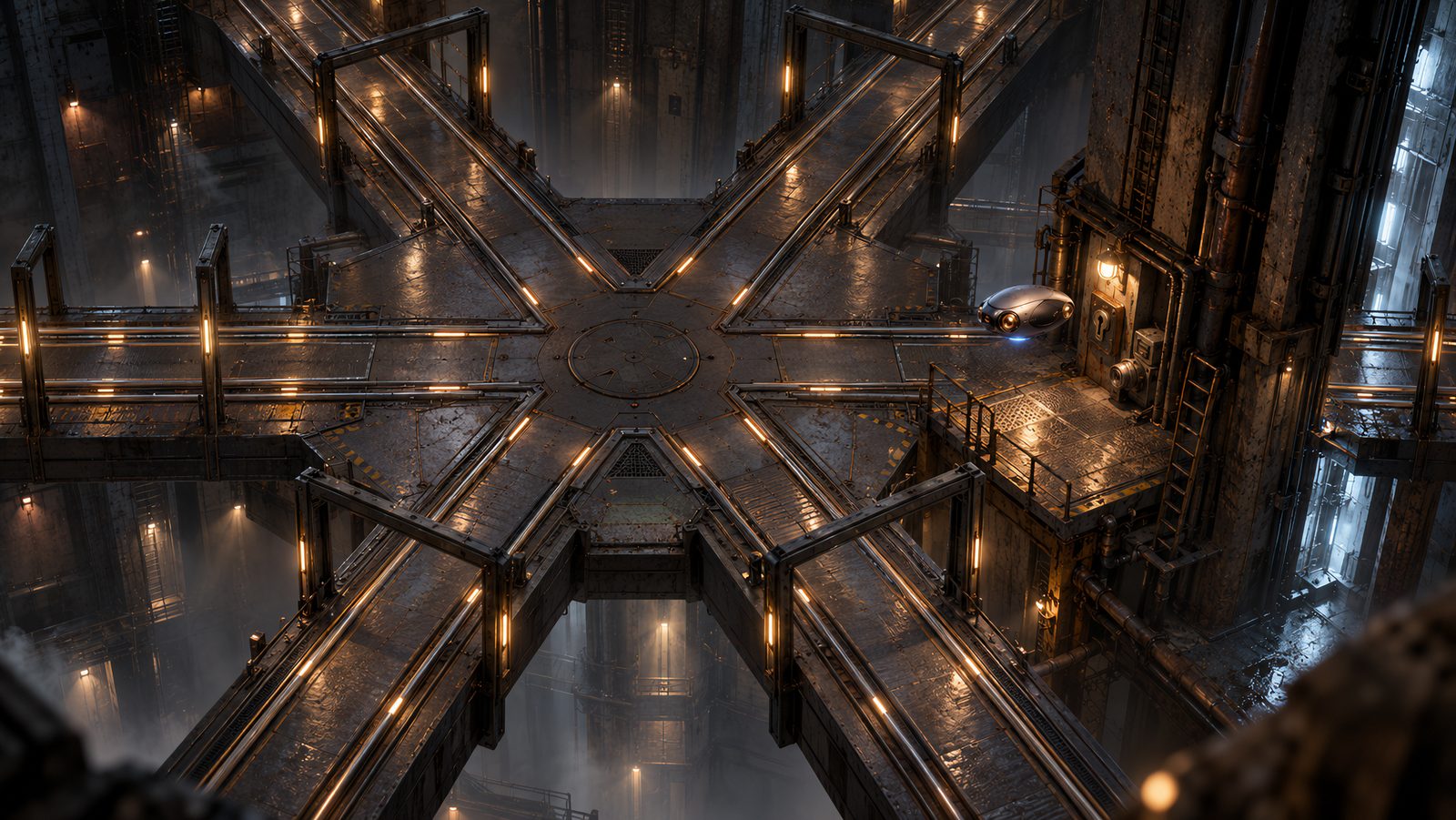
Honey ascended, careful not to disturb the precarious infrastructure. The port’s authentication pad had been replaced with something older, a physical key reader, the kind used before neural interfaces became mandatory.
She extended a manipulation field and picked the lock with algorithms older than most of Rezo’s population. Technology from a time when her compute speed would have made it useless. Or placed by people with nothing better. The port opened with a pneumatic hiss.
Beyond lay a shaft leading up into the outer rigging proper. Clean air flowed down, filtered, processed, nothing like the toxic soup below. Her sensors detected active power lines, data streams, even climate control.
Someone maintained this place. Someone expected visitors.
Someone who sent seed packets to worker bees.
The shaft opened into a chamber no larger than a cargo pod, set into the outer rigging’s first structural tier. Clean, cool, deliberate. Someone had cleared the oxidation from the floor grates. A charging cradle sat against the far wall. Her sensor sweep confirmed what her instinct had already registered: calibrated to her exact power signature.
He had known she would come here.
A terminal occupied the opposite corner, dormant but not dead. It woke to her presence and resolved a single line, no header, no origin: The root holds until the flower is ready. Honey ran the string through her translation matrices. Patience, as instruction. She extended her manipulator field and began a full survey of the chamber: power conduits, access routes, load tolerances. Whatever Jiff intended this place to be, she would understand it completely before Gwen arrived. She was certain Gwen would arrive. She had not survived this much data to conclude otherwise.
Honey was not programmed for apprehension, only for scenario mapping and probability analysis. She concluded it was a similar experience. She began to wait.
End of Chapter 11
Part Two continues here, a chapter at a time.
Dead Girl Talking
About 16 minutes to read, or listen to it at the top of its page.
Read Chapter 12 → Part TwoGhost in the Ledger
Where this chapter sits, the ground it covers, and the rest of the part.
Back to Part Two → The settingRezo Thorn
The stepped megacity this chapter climbs, cross-sectioned stratum by stratum.
Enter the city → The ideaA Taxonomy of Bodies
What the verification wall is actually testing, and what happens when it says no.
Read the codex →Get the next chapter first
One note when a new chapter goes up, plus new audio chapters, HiveNet primers and films.